Kashubian Emigration
Kashubians were the first group of Poles who began emigrating, starting in 1855 up to the end of World War I in 1918. The peak of Kashubian emigration was in the early 1880s.
Why They Emigrated
The Kashubians began emigrating in the mid-1800s for several reasons:
- As a result of the partitioning of Poland, the Kashubs were early targets for Prussian and German control and were met with institutionalized hostility.
- The threat of conscription into the Prussian army also influenced young men to leave their homeland.
- It was illegal to use the Kashubian language in public, including in churches and schools.
- Many priests were imprisoned or exiled, so churches were left with no parish priests.
- The Kashubian ethnic identity was also being threatened. Those who accepted German authority were rewarded and those who opposed it were punished or discriminated against.
- Poverty also played a major role in emigration.
Ports of Departure
The Kashubians emigrated from several different European ports between the 1850s and the 1890s. The German ports of Hamburg and Bremen were the most popular, and Kashubians traveled by train from Gdansk to those ports.
Rooming houses and special halls were available at the Hamburg and Bremen ports where the emigrants could stay until their ship was ready to set sail, though the conditions were crowded and dirty. Also, emigrants were often taken advantage of and charged higher fees for the rooms.
German Passenger Lists
While the Hamburg Passenger Lists are available, it is unfortunate that most of the early Bremen passenger departure lists (from 1875 to 1908) were destroyed. As a result, the arrival ports are the only way to get ship records that originated from Bremen.

PGS-MN Newsletter Article
| Newsletter Issue | Page | TItle/Author |
|---|---|---|
| Summer 1997 | 1 | Searching Ships’ Lists for Your Polish Ancestors: Passengers on the Ship, the Bark Agda by Shirley Mask Connolly |
Ports of Arrival

Baltimore and New York were common arrival ports. Some sailed to England and re-embarked from Liverpool or London, with an endpoint in New York. Other routes to North America were through New Orleans or Quebec.
In the 1850’s, it was a three month trip by sea from Kashubia to the United States and the cost was about $60 per person. Once on the ship, the emigrants were in crowded conditions below deck, which had been built to transport cattle (which explains why below deck was labeled as steerage). Illness and disease were easily spread and some died on the ship.
Families were limited in how much they could carry on to the ship, often one box that contained their food for the journey, which left little room for physical possessions. Prayer books, rosaries, crucifixes, and recipes were common items that were brought over.
Because Kashubians left Poland during the time of the Partitions, Poland did not politically exist, so they usually claimed Prussia as their country of origin when immigrating and when becoming naturalized.
KANA (Kashubian Association of North America) Article about Kashubian Emigration
| Newsletter issue | TItle/Author |
|---|---|
| Summer 2008, page 4 | About Castle Garden: Notes from an 1871 article by Blanche Krbechek |
| Summer 2012, page 1 Summer 2012, page 2 | Some Entered Through the Port of Baltimore by Jennifer Jones Freiman |
Kashubian Settlement – Renfrew County, Ontario
Many Kashubians came through Quebec and settled in Renfrew County, Canada, starting around 1858.
KANA (Kashubian Association of North America) Articles about Kashubians in Canada
| Year/Issue | TItle/Author | Comments |
|---|---|---|
| Spring 1997 – page 10-11 | Arrival on the Agra and Searching Ship Lists by Shirley Mask Connolly | Lists names, some continued on to the U.S. |
Kashubian Minnesota Settlements
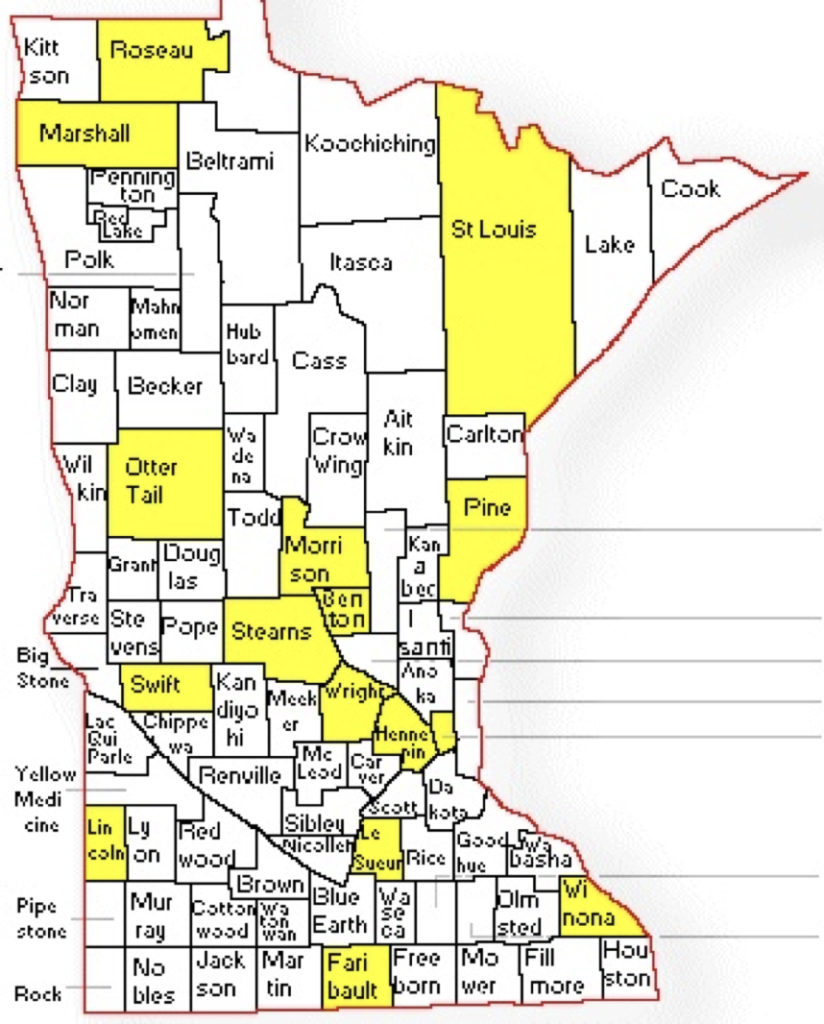
- Winona, Winona County – largest settlement
- Central MN (Morrison, Benton, Stearns Counties)
- Twin Cities (St. Paul, New Brighton, Delano)
- Pine County (Sturgeon Lake)
- Pine Creek, WI (just across the river from Winona)
Many Kashubians traveled to the United States, particularly to the cities of Winona, Minnesota, as well as Dodge and Pine Creek, Wisconsin (just across the river from Winona). Kashubian immigrants were the earliest significant Polish immigrants in Minnesota and started settling in Winona in 1855. They arrived in New York, traveled to St. Louis, Missouri by train, then took a Mississippi steamboat up river to Winona. The expansion of railroads in the mid-1800s replaced steamboat travel, providing easier routes to get to Minnesota.
Some Kashubians settled in rural parts of Minnesota, and other cities such as Sturgeon Lake, in Pine County in Northeastern Minnesota, as well as New Brighton and St. Paul in Ramsey County. Another area where Kashubians settled was in Morrison County in Central Minnesota. Some of the Winona Kashubians and the Morrison County Kashubians were from the same families.
Other parts of the country where they settled were Stevens Point and Polonia, both in Portage County, Wisconsin; Buffalo, New York; Chicago, Illinois; Walsh County and Stutsman County, North Dakota; Montana, and Detroit, Michigan.
Portage County, WI
Some Kashubians settled in Central Wisconsin, in Portage County.
KANA (Kashubian Association of North America) Articles about Kashubs Who Settled in Portage County, WI
| Newsletter issue | TItle | Author |
|---|---|---|
| Spring 2004 – page 4 | Konkol’s Corner’s Shrine | Adeline M. Copa/Sopa |
Jones Island – Milwaukee, WI
A group from the northern part of Kashubia (the Puck area and Hel Peninsula) settled in Milwaukee, Wisconsin.
KANA (Kashubian Association of North America) Article about Kashubs Who Settled at Jones Island
| Newsletter Issue | Title/Author |
|---|---|
| Summer 1998, page 4 | Who Were the Kashubs? by Ruth Kriehn |
| Spring 2002, page 1 | Kashubian Fisherman’s Village on Lake Michigan Translated by Renata Stachowicz 90 families from the Hel Peninsula area settled in Jones Island (Milwaukee) |
| Summer 2002, page 8 | Kashubian Fisherman’s Village on Lake Michigan – Part 2 Translated by Renata Stachowicz |
| Spring 2011, page 1 | A Little History of Jones Island, Milwaukee, WI by Madaly Finstad |
Book About Jones Island
The Fisherfolk of Jones Island
by Ruth Kriehn 1988
Walsh County, North Dakota
Some Kashubians moved from Minnesota to Minto, Warsaw, and Pulaski Township in Walsh County, North Dakota. Many were secondary settlements from Perham, Winona and Pine Creek, WI. They came in the late 1870s-early 1880s, in search of farmland. They built sod and log home, cleared the land and planted wheat and oats.
Some Kashubians also settled into farming near Jamestown, Stutsman County, North Dakota.
Below is a link to biographies of early pioneers in Walsh County (from the Walsh County Historical Society). It is over 1200 pages – if you have ancestors who settled there, you will find some good information.
KANA (Kashubian Association of North America) Articles about Kashubs Who Settled in North Dakota
| Newsletter Issue | Title/Author |
|---|---|
| Spring 2004, page 1 Spring 2004, page 2,3 | Stoltman Clan in North Dakota |
| Winter 2002, page 1 | Story of Fortitude and Courage: Brief History of St. Stan’s Parish in Warsaw, North Dakota – Part 1 from the Diamond Jubilee Book (1900-1975) |
| Winter 2002, page 4 | Pioneers in the Warsaw Community: Brief History of St. Stan’s Parish, Warsaw – Part 2, 3 from the Diamond Jubilee Book (1900-1975 |